
Posted by Kris Allo on Apr 3rd 2026
Biophilic Design: The Space Your Nervous System Has Been Asking For
You know how your nervous system starts to protest after too many hours under artificial light? Or too many days without a horizon, too many weeks in spaces full of unrelenting hums and buzzes and dings?
Something hasn’t been right, and it wants you to know.
So then you sit near an open window. You walk under a canopy of trees. Or you get yourself near a body of water, and something in you exhales and reconnects.
That’s not your personal preference, it’s your biology. Yours, mine, all of ours.
More than 99% of human history was spent in direct relationship with nature. We were encoded by it from the start. Our nervous systems developed by learning to read it, to regulate in it, and to interact with it.
That encoding doesn’t disappear because we moved indoors.
Our bodies are still running that ancient program even though today, most of us spend close to 90% of our lives inside buildings.
But interior design is paying attention to that gap; it’s bringing the outside in with biophilic design. The word biophilia comes from Greek, meaning love of life. Biophilic design asks what it would mean to honor that love . . . to stop treating our need for nature as a nice-to-have, and start designing around it as the biological necessity it actually is.
What Is Biophilic Design?
Biophilic design isn’t just decorating with nature. A space could be full of botanical prints and terracotta pots and still fail to deliver what a truly biophilic environment provides: the right conditions for our thriving.
Biophilic design focuses specifically on those aspects of the natural world that our ancestors would have read as signs of safety, sustenance, and life. This includes things like natural light that shifts throughout the day, materials with imperfect and interesting textures, the presence of living systems, and organic shapes that give the eye places to rest.
The case for biophilic design is backed by data.
Researchers studying workplaces, hospitals, schools, and homes have documented the same pattern: when people inhabit spaces with natural light, organic materials, and living plants, their nervous systems respond in measurable ways. Heart rates slow. Blood pressure drops. The brain shifts into modes associated with restoration rather than vigilance.
The goal isn’t a more beautiful space; it’s a more inhabitable one.
Five Ways to Bring Biophilic Design Home
It begins with the intention to speak to the nervous system in the language it knows best. Here are five accessible and impactful places to start:
- Natural light (and its companion, shadow). Maximize light that enters from outside and changes throughout the day. Resist the urge to eliminate shadow entirely—contrast is part of what makes natural light feel alive.
- Living plants. Plants breathe, respond, grow, and change, introducing a quiet dynamism that the nervous system registers.
- Organic materials with history. Reach for surfaces that carry the evidence of their origin: wood with grain that tells the story of a tree, stone with the variation of geological time, natural fibers with the irregularity of something made by hand.
- Water—including sound as much as sight and touch. Even a small bubbling fountain or recorded water sounds have been shown to reduce cortisol.
- Nature’s geometry. Introduce organic forms like branches and spirals through furniture, textiles, or art to return your visual environment to something your inner being recognizes.
Nature-Based Art
While it’s not technically biophilic design, science has found that nature-derived imagery produces positive neurological responses. The nervous system reads patterns, organic color, and the geometry of things that grow and move as the visual language of nature.
But not all nature-inspired art carries the same quality.
This is where the artists in Change Your Energy’s Art Gallery occupy different ground. They don’t just paint landscapes or botanicals. As artists deeply grounded in meditation and spiritual practice, their work uses the natural world as a portal to something deeper.
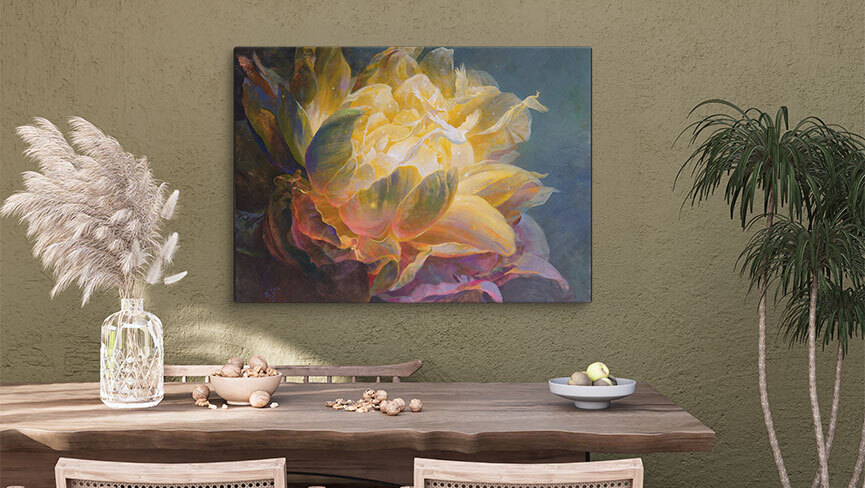
Take Al Choi’s Golden Flower for example. This radiant bloom represents an opening of consciousness that expands to cover the entire universe, and leads to the union of human divinity with the cosmic divine. Viewing this painting, you can connect to your ancestral physiology that developed inside nature, and even beyond that to your spiritual oneness with the source of life itself.
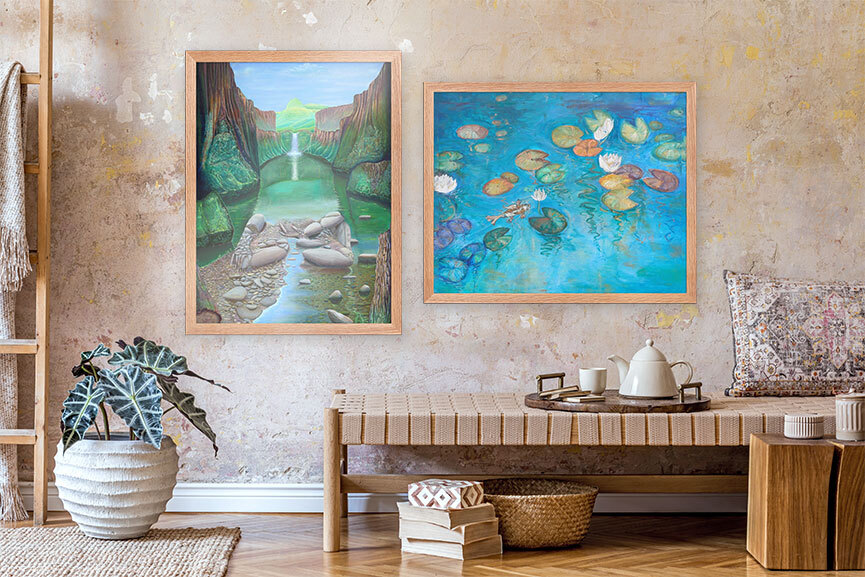
Other examples are Matthew Smith’s Stream of Consciousness, which connects you to water and the spiritual awareness that comes with time spent in nature, and Karina Woldt’s Koi in Lotus Pond, where the water’s surface creates a sense of calm through which the Buddhist symbol of spiritual awakening emerges.
These artists went all the way in, and brought something back.
Bring this kind of art into your space . . . not instead of a living plant or a south-facing window, but alongside them as another layer of energy that returns you to the essence of who you are.
A Place to Begin
Biophilic design ultimately asks us to reorient to what the body has always known, and what the research confirms: that we are nature, and we do better when we remember it.
The artists at Change Your Energy take that reorientation one step further. They ask us to pay attention not only to our relationship with the natural world, but with the something-beyond-it that nature has always pointed toward.
If you’re building your home with intention, consider including energy art in your design. Browse our energy art prints and products here.