

Posted by Kris Allo on Mar 13th 2026
What Neuroaesthetics Reveals About the Art You Live With
Did you know that the art on your walls impacts your brain?
Neuroaesthetics is the study of how the human brain responds to beauty, form, color, and other aspects of an artistic experience. Sitting at the intersection of neuroscience, cognitive science, and the humanities, it asks a deceptively simple question: when we experience art, what actually happens inside us?
The research findings are both fascinating and, for those of us who have always felt moved by works of art, validating.
Your Brain on Beauty
In neuroimaging studies at University College London, participants lay inside fMRI scanners—machines that track blood flow through the brain in real time—while looking at different paintings.
When a person rated a painting as beautiful, a specific region of the brain consistently lit up: the medial orbitofrontal cortex. It’s a part of the brain associated with pleasure and reward.
The response isn’t limited to beautiful paintings. It’s the same region that responds to the face of someone you love, or to music that gives you goosebumps. Activity in this region spikes in response to beauty across every form, whether it’s visual art, music, mathematics, or even moral experiences. The stronger the perceived beauty, the stronger the signal.
Scientists have also used eye-tracking to map exactly where people look when they encounter a work of art, how long they linger, and how those patterns connect to emotional and physical responses. It turns out that the body has a lot to express about what it finds beautiful.
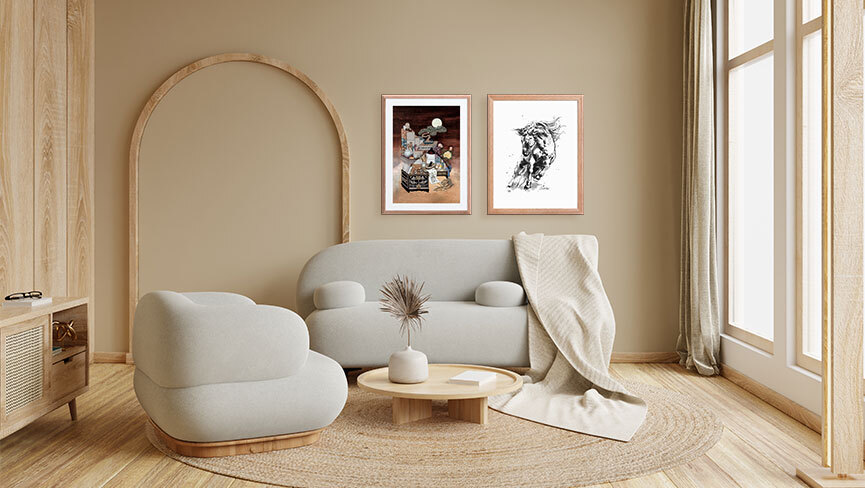 [Image includes After Everyone Falls Asleep by Meekyung Shin (left) and Horse Ink Painting 9 by Al Choi (right)]
Professor Nancy Etcoff of Harvard Medical School says that when a work of art truly affects you, two brain systems that are normally separate fire at once: the part of your brain focused on the external world—the artwork in front of you—and the default mode network (DMN), the inner world of mind-wandering, memory, and self-reflection.
It’s a whole-brain event, simultaneously using many parts of the mind that are typically unconnected. That may be why the experience is so hard to put into words, and yet can feel so profound.
But neuroaesthetics goes beyond the walls of universities and research labs. Many hospitals and rehabilitation centers use carefully chosen art in patient rooms with measurable results. Studies show they lower stress, reduce perception of pain, and shorten recovery times in some cases.
If art can do that in a hospital room, consider what art might do in the rooms where you spend your time.
Beyond the Explainable
Neuroaesthetics can explain the mechanisms, but it doesn’t solve the mystery of why art moves us. It doesn’t need to. Being moved by art is part of the transcendent human experience, one that connects us to something greater than the physical, and greater than what the mind alone can comprehend.
If you’ve ever felt calmed by a color, connected to the divine, moved to tears, or lifted by a piece of art in a way you couldn’t explain, you already know this is real.
So the question is: what kind of art do you want working on you every day?
What’s on the walls of the rooms where you spend the most time? What colors surround you? What is your nervous system processing, consciously or not, every time you sit down at your desk or settle into the couch?
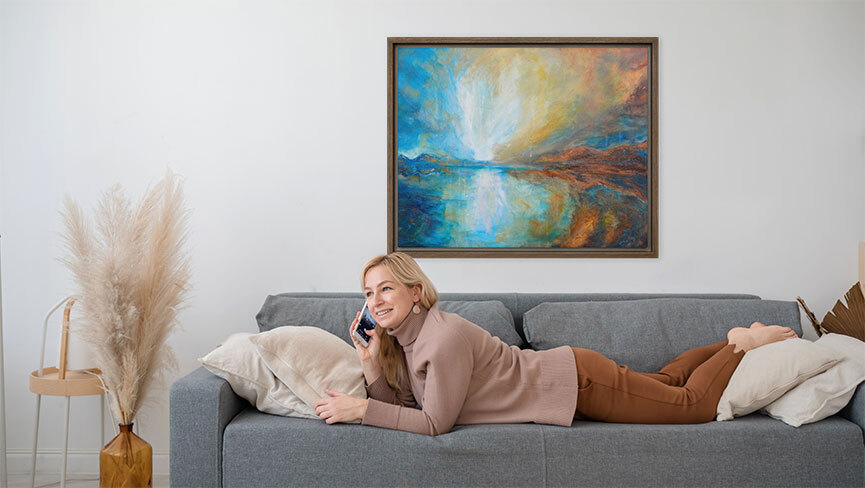 [Image includes Sunrise Above Loch Lomond by Karina Woldt]
Your visual environment shapes your inner state in both measurable and immeasurable ways. A single, intentionally chosen piece of art that speaks to something in you is not neutral. Neither is a room full of imagery you feel nothing for.
The Change Your Energy guide to spiritual art explores this kind of intentional curation and how to choose art that supports the states you want to cultivate.
What Spiritual Practitioners Know About Art
Long before neuroaesthetics had a name, spiritual practitioners already understood that a painting is not just an object, but an active presence. That it is capable of shifting something in the body and mind of the viewer.
This is why Change Your Energy features art from energy masters and longtime meditators. These are artists who create from a place of conscious awareness, so that what they make carries something the viewer can feel. Their work is designed to shift your internal state and connect you to the parts of yourself that express the highest and best—for you, and for all of life.
Check out the Change Your Energy Art Gallery to explore these works in various sizes and formats you can bring into your home.