

Posted by Kris Allo on Jan 30th 2026
The Sun, the Moon, and the Five Peaks (Irworobongdo) by Meekyung Shin
Irworobongdo—translated as The Sun, the Moon, and the Five Peaks—is one of Korea’s most enduring symbolic images. It originated during the Joseon Dynasty, when it was traditionally painted on large folding screens placed behind the king’s throne.
The elements represented the universe in balance, and as the king was positioned at the center, it seemed to emphasize royal authority as part of the cosmic order.
Irworobongdo emerged during a time when political change, natural disasters, and questions of cosmic order were deeply felt. Images of balance and harmony became especially meaningful; the screen affirmed the king’s role as a mediator between heaven, earth, and human society.
Only around twenty historical Irworobongdo screens are known to survive today, many housed in Korean palaces. But the image remains a powerful cultural symbol. It appears on South Korea’s 10,000 won banknote and has also appeared in modern media, including the popular 2025 film KPop Demon Hunters.
But artist Meekyung Shin's version of Irworobongdo, found in our Energy Art Gallery, offers a different vision.
Rather than emphasizing royal authority or requiring a mediator between humans and the cosmos, her painting invites a direct, personal connection. She describes it as "a landscape of balance and resonance"—one where we can feel our own inner being connecting with the elements and transcending time.
The Symbols of Irworobongdo
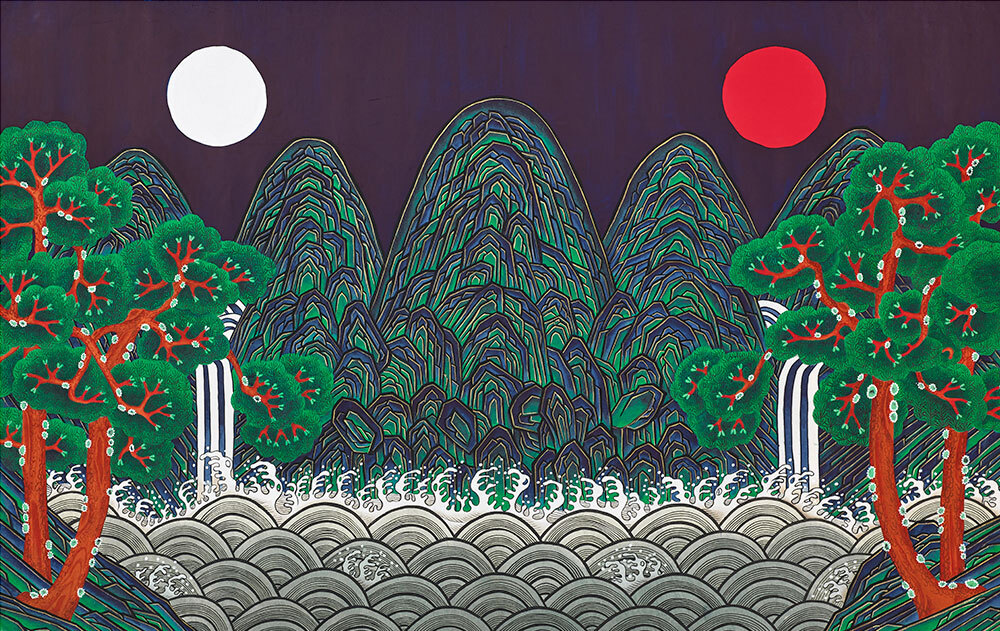
Irworobongdo paintings typically depict:
- A red sun and white full moon, representing yang and yin—the active and receptive, radiant and reflective energies that rely on each other
- Five mountain peaks rising at the center, symbolizing stability and continuity
- Flowing waterfalls and streams
Evergreen pine trees, symbols of endurance
In the traditional Joseon court version, the sun was associated with the king and the moon with the queen. Together, they expressed the idea that harmony arises through complementary forces held in balance. The five peaks anchored the composition, symbolizing the sacred landscape and enduring stability of the kingdom itself.
In Meekyung Shin's reimagining, these same symbols take on a more personal meaning. The sun and moon are no longer about royal authority. They’re a reflection of the rhythms inside each of us. The peaks aren't only the kingdom's landscape; they're an inner anchor we can return to when life feels unsteady.
A Reminder We Can Lean On in 2026
Just as Irworobongdo emerged during the Joseon Dynasty in a time of political upheaval and natural disasters, it speaks to us again in 2026—another moment when the world seems in a state of turmoil and instability.
At its heart, Irworobongdo reminds us that balance already exists, even amid chaos. The sun and moon show us that opposing forces don't cancel each other out. They rely on one another to exist. Fire and water. Action and trust. Movement and stillness.
The five peaks stand steady through it all. Something enduring remains, even as the world shifts around us. The changing and the unchanging.
In times like these—marked by intense energy—this painting invites a grounded stance. Steadiness. Trust in the natural rhythm of things unfolding.
We don't have to solve everything. Instead, we ground, we breathe, we look to the sky, and we realign with balance.
Bring the balancing energy of Meekyung Shin's “The Sun, the Moon, and the Five Peaks (Irworobongdo)” into your space with a fine art print, available on canvas or paper. Find it here.