Posted by Kris Allo on May 31st 2026
Healing Symbols in Art and Their Meanings: A Guide to Symbolism in Energy Art
Healing symbols in art are a visual language—one that bypasses the analytical mind and speaks directly to the body, the nervous system, and something older than conscious thought. Across cultures and centuries, certain shapes, animals, and forms have been used to represent and transmit energy, healing, and spiritual meaning. Understanding them doesn't just satisfy intellectual curiosity. It deepens the entire experience of living with energy art.
Table of Contents
- Why Healing Symbols in Art Matter
- The Body Responds Before the Mind Does
- The Spiral and the Vortex
- Sacred Geometry: The Mandala
- Chakra Symbols and Their Meanings
- The Third Eye: Awakening Awareness
- Animal Symbols: Tiger, Dragon, and the Zodiac
- Natural Motifs: Lotuses, Longevity, and Growth
- Shared Symbols Across Cultures
- Choosing Art by Its Symbols
Why Healing Symbols in Art Matter
Understanding symbolism in energy art gives you access to a deeper experience. The emotional response you were already having—that pull toward a certain painting, or the sense of calm or expansion you feel from it—becomes legible. You're not just moved by something you can't explain. You understand why it's moving you, and that can give you a deeper understanding of yourself.
There are practical benefits too. If you’re choosing art for a meditation room, a healing corner, or a child's bedroom, you can use symbolic meaning as another layer to consider when making the choice. A piece becomes a tool rather than decoration. It carries intention into the space and becomes an instrument for something beyond decoration.
And at the deepest level, healing art meaning extends beyond the viewer's personal experience. Recognizing shared symbols across cultures—like a spiral in Celtic stone carvings and in Korean Minhwa, a lotus in Buddhist and Hindu traditions—creates a sense of belonging to something larger than one's own life. That sense of connection is itself a form of healing.
The Body Responds Before the Mind Does
This is perhaps the most important thing to understand about healing symbols in art: they work whether or not you consciously recognize them.
The body responds to healing symbols before the mind has named them—a softening, a deeper breath, a sense of settling or expansion. This isn’t your imagination. It’s the nervous system responding to visual information that carries energetic meaning.
Certain visual qualities in healing art—soft circular forms, warm luminous color, flowing lines—have a measurable calming effect on the autonomic nervous system. A spiral reminds us of our own rhythms. Nature symbols remind the body that it is at home with life. Intentional symbols help the body move toward coherence.
Symbols charged with healing intention across centuries also carry accumulated energetic weight. Encountering them in consciously created art can move the emotional body in ways that have nothing to do with intellectual understanding. Grief surfaces so it can be moved through, tenderness and compassion arise. Something that was contracted and tight releases.
At the deepest level, healing symbols speak to what many traditions call the soul—the true self that recognizes something before the mind can explain it. This is the experience of being stopped by a piece of art because some ancient part of you already knows it.
The Spiral and the Vortex
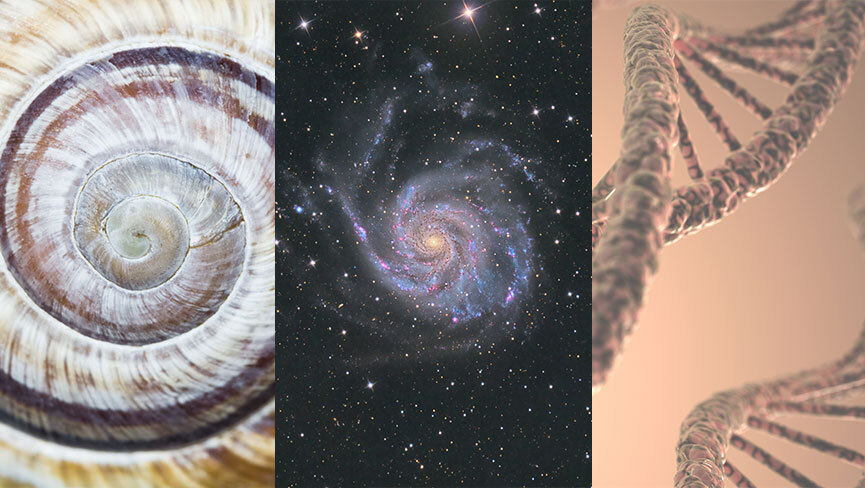
The spiral is one of the oldest symbols for positive energy in the human visual record. It appears across cultures and centuries—in nautilus shells, in galaxies, in the double helix of DNA. When energy artists build compositions from spiraling vortex forms, they're drawing on something embedded in the way life itself moves.
The spiral carries the idea of growth and return simultaneously. It expands outward while remaining connected to its center. In energy practice, this maps directly onto the chakra system—spinning energy centers that, when open and balanced, allow life force to move freely through the body.
Sacred Geometry: The Mandala
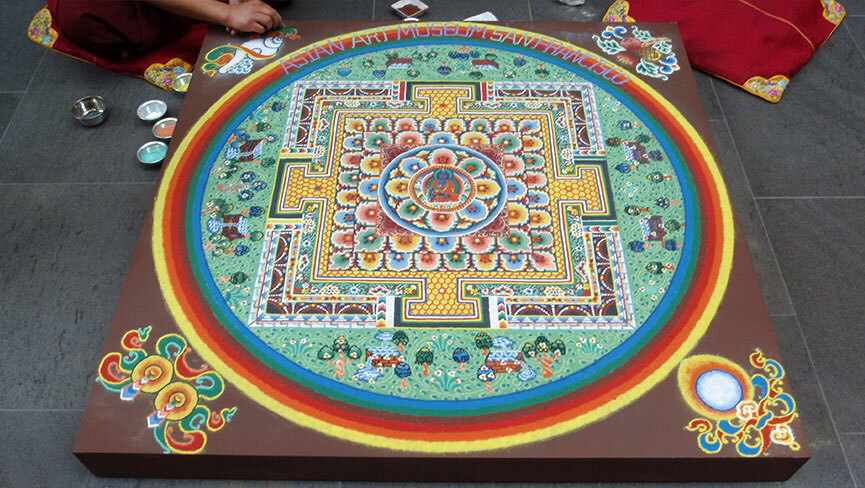
The mandala is a circular geometric pattern representing the universe, wholeness, and spiritual enlightenment. Rooted in both Hinduism and Buddhism, mandalas have been central to meditation practice for centuries—used to focus the mind and reflect the interconnectedness of all things.
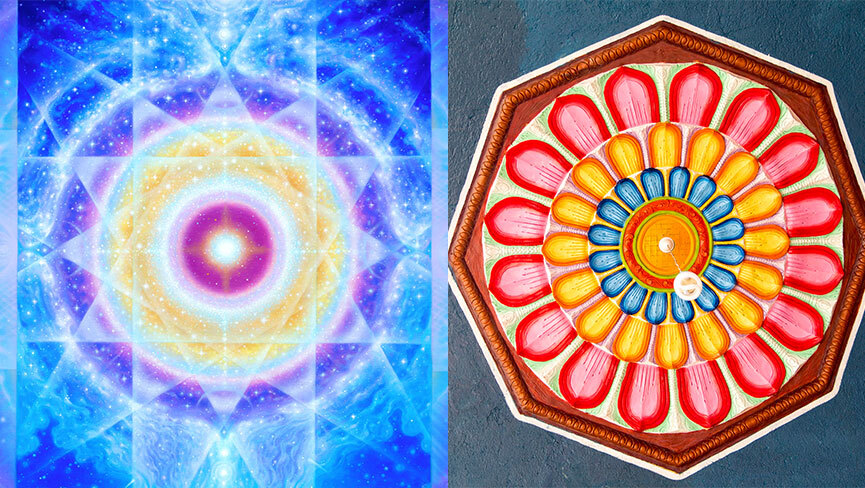
What makes the mandala potent as a healing symbol is its structure: everything radiates from a central point. That center represents the stillness from which everything arises. The layers that radiate outward represent the unfolding of consciousness, or in energy terms, the expansion of awareness from a quiet, grounded core.
Circles, geodes, and mandala forms speak to the subconscious in a language it already understands. The mind settles into the image without needing to consciously analyze it.
Chakra Symbols and Their Meanings
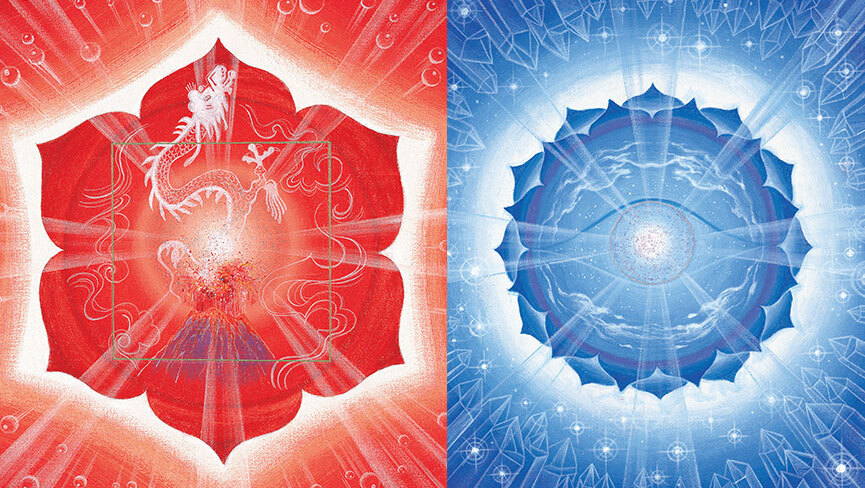
The chakra system maps seven primary energy centers in the body, each associated with specific qualities of consciousness, emotion, and physical wellbeing. Chakra symbols have been refined across thousands of years of yogic and Tantric tradition, and contemporary energy art often works directly with this map.
Each chakra has its own color, geometry, and symbolic correspondence. The root chakra grounds and stabilizes. The sacral chakra holds creativity and flow. The solar plexus carries personal power. The heart opens to love and connection. The throat holds authentic expression. The third eye governs intuition and expanded perception. The crown connects to universal consciousness.
When art is created with awareness of these energy centers, it can support the viewer's energetic alignment. The Change Your Energy Chakra Art Collection brings this principle to life with paintings that connect to each energy center and complement chakra-focused meditation or healing practice.
The Third Eye: Awakening Awareness
Across spiritual traditions, the eye has long represented something beyond ordinary sight. The third eye—the sixth chakra—is the seat of intuition, inner knowing, and expanded perception. When it opens, awareness moves beyond the limits of the physical senses.
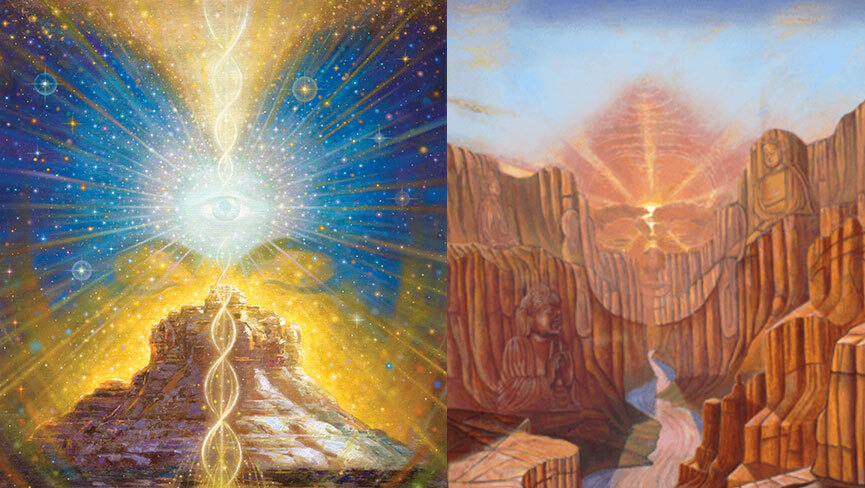
This symbol appears in several works in the Change Your Energy gallery. In Bell Rock Meditation by Al Choi, a third eye awakening symbol is seen at the top of the energy spiral. In Dawn of Consciousness by Matthew Smith, a figure's face radiates light from the third eye area, a transmission of awareness breaking through into something wider and clearer.
Art carrying the third eye symbol can support meditations focused on the sixth chakra, and serve as a reminder that our perception is not fixed. Consciousness expands and awareness deepens with focus.
Animal Symbols: Tiger, Dragon, and the Zodiac
Animals carry some of the oldest symbolic energy in art. In Minhwa—Korea's folk art tradition rooted in shamanism, Buddhism, and Taoism—each animal symbol carries a specific energetic purpose, working as an anchor to direct qi (life force) inside a space.
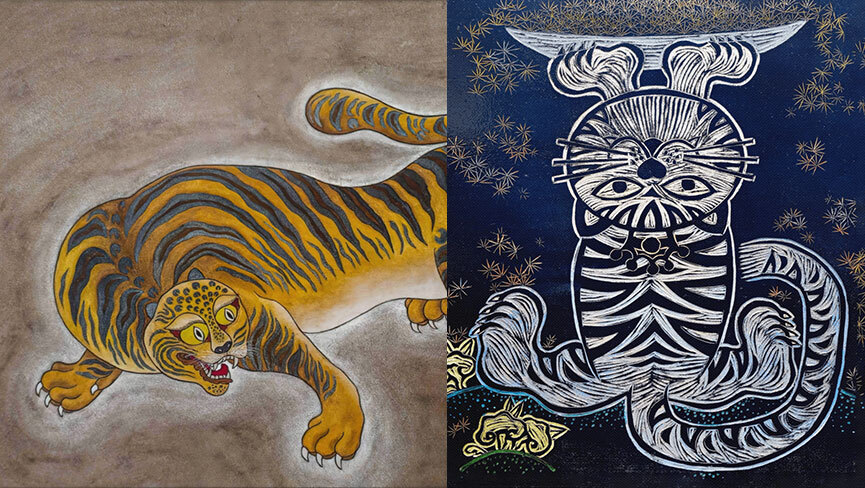
The tiger is a guardian: a protector at the threshold between the ordinary world and something greater, a bearer of good fortune, and a symbol of vitality and awakening. In our recent blog article, we covered several artists in the Change Your Energy gallery who have brought their own version of tiger energy to life.
In A Day Full of Abundance by Meekyung Shin, the tiger carries pine needles—symbols of longevity—and tends to life with protective, sustaining energy.
In Awakening Inner Strength by Yesang Lee, the tiger is fierce and luminous, calling forth the strength that is always present inside.
In Tiger of the Lotus by Karina Woldt, the tiger sits among lotus flowers—strength and spiritual growth in the same image, showing that power and softness are not opposites.
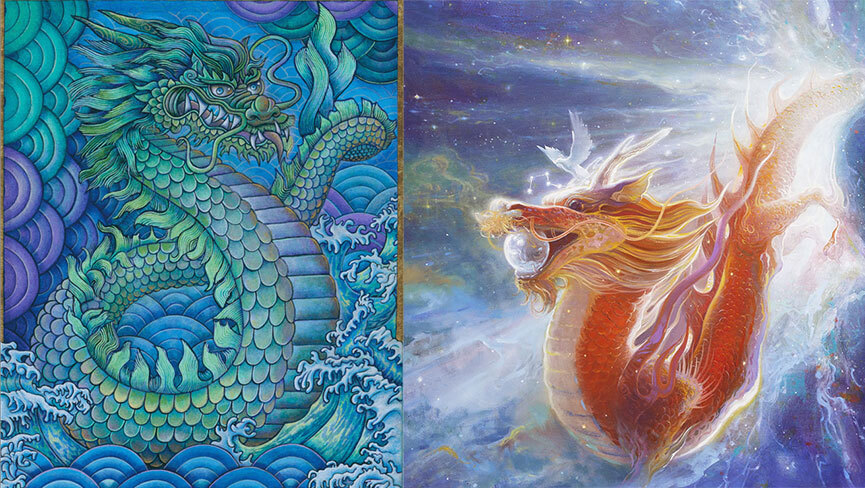
The dragon in Eastern tradition is not the destructive force of Western mythology. Eastern cultures hold the dragon as a protector and bringer of life—a being of wisdom, strength, protection, and prosperity. Blue Dragon by Matthew Smith embodies this fully. Its blue tones and water motifs evoke the tranquil, flowing strength of a force that works with life, not against it.
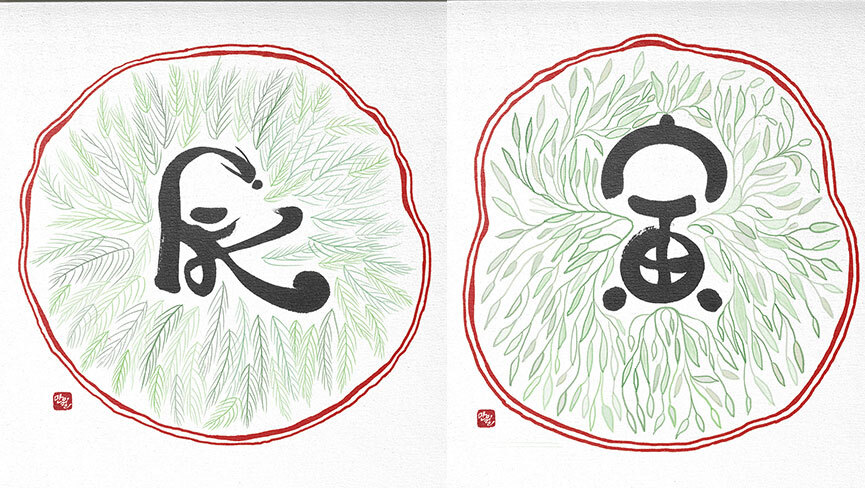
Zodiac animals extend this tradition across a 12-year cycle, with each year’s animal encoding specific qualities. In Tao Master Manwol's Zodiac Animals series, each animal is not an illustration but an energy vessel, carrying the essence of its archetype.
Natural Motifs: Lotuses, Longevity, and Growth
Healing symbols in art also draw heavily on the natural world. Branching lines, seed shapes, and floral patterns appear across cultures as emblems of growth and transformation.
In Korean Minhwa, this comes to life through the Ten Symbols of Longevity (Shipjangsaengdo):
- sun (vitality and enlightenment)
- clouds (flow and adaptability)
- mountains (steadfastness)
- water (renewal and purity)
- pine tree (endurance)
- turtle (wisdom)
- deer (grace and peace)
- crane (moral strength and longevity)
- peaches (abundance)
- the Yeongji mushroom (rejuvenation)
Together, these ten symbols promise health, endurance, and vitality.
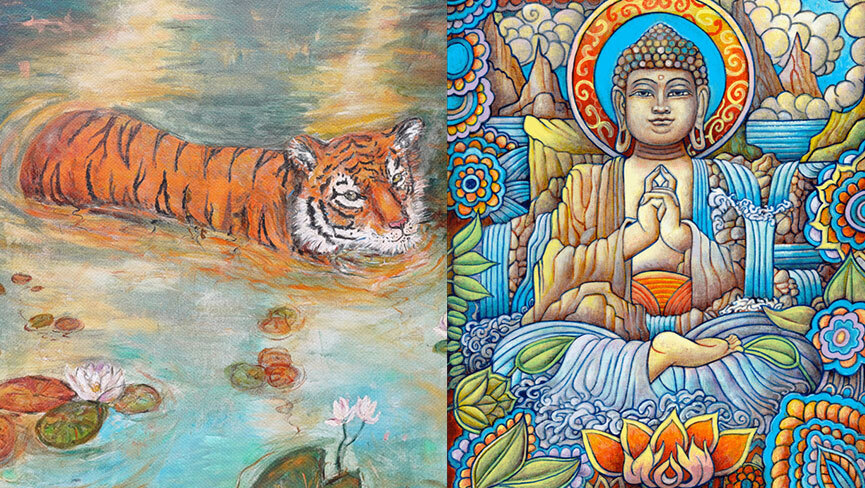
The lotus deserves special attention. Growing from muddy water, it represents spiritual growth, purity, and the unfolding of the soul. In Buddhist and Hindu traditions, it’s one of the central symbols of awakening. It embodies the wisdom that clarity and beauty arise through difficulty, not in spite of it.
The lotus appears in the Change Your Energy gallery in Karina Woldt’s Tiger of the Lotus and in Elements by Matthew Smith, where a Buddha surrounded by the four elements—earth, water, fire, and air—holds the lotus as a symbol of stillness and mastery. Balance comes through awareness, not through the absence of forces.
Shared Symbols Across Cultures
One of the most beautiful aspects of learning about symbolism in energy art is discovering that the same forms appear independently across cultures that didn’t necessarily come in contact with each other.
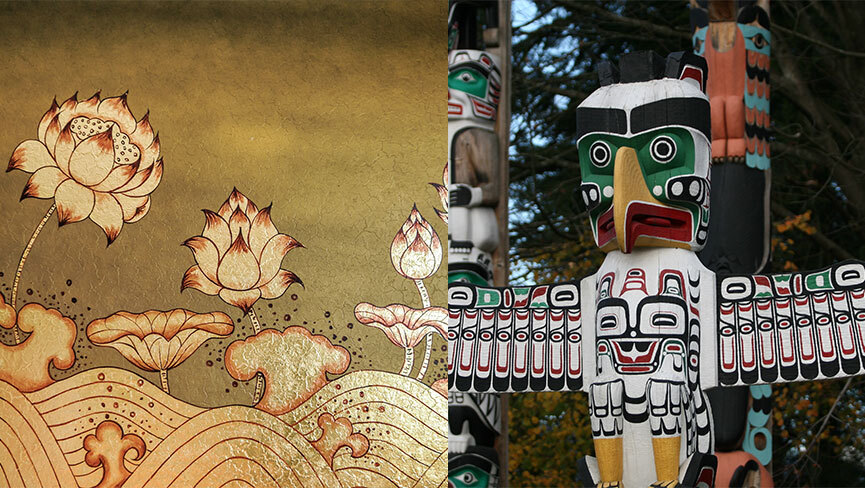
The spiral appears in Celtic stone carvings, Korean Minhwa, Indigenous American pottery, and Maori tattoo tradition. The lotus appears in both Buddhist and Hindu sacred art. Protective eye symbols exist in ancient Egyptian, Greek, and Middle Eastern traditions. The mandala appears in Tibetan Buddhist thangkas, Navajo sand paintings, and the rose windows of European cathedrals.
This suggests that certain visual forms carry meaning because of something shared in human consciousness. Encountering these symbols connects us to that larger sense of belonging to something older and wider than one's own life. That, in itself, is a form of healing.
Choosing Art by Its Symbols
When choosing art, rather than selecting purely by aesthetic appeal, you can choose by resonance—by what a piece is transmitting and whether that transmission matches your intention for the space. A meditation room calls for different symbolic content than a child's bedroom or a home office. A place intended to support healing after loss asks for different symbols than one intended to inspire creativity. Energy art changes how a space feels, not just how it looks.
The symbols explored here—spiral, mandala, lotus, third eye, tiger, dragon, crane, and many others—have carried meaning for centuries as active transmissions of energy and intention. The artists who work with them today carry that lineage forward.
Each of the artists in the Change Your Energy Art Gallery has a living practice of working with the deeper aspects of life, and brings that presence into their work. Find art prints in various sizes and formats, all created with intention, here.