
Posted by Kris Allo on Oct 16th 2026
“On What Has Been Lost” by Meekyung Shin
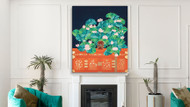
Meekyung Shin's painting On What Has Been Lost was inspired by the rediscovery of Korea's lost royal seals. It reflects on loss and return, and on what happens when something separated from its origin is found again.
For centuries, the eobo—the royal seals of the Joseon Dynasty—were carved as the formal emblem of a king or queen's authority, made with care and kept under strict guard as symbols of the throne.
But during the 20th century, many of these seals were separated from Korea. Some were taken during the Japanese occupation, and others disappeared in the chaos of the Korean War. They surfaced later in private collections and foreign museums, sometimes for more than sixty years, before they were returned home.
According to Meekyung Shin’s description of her painting, the return of the seals wasn’t just the recovery of an object. It was a symbol of continuity—proof that what was set apart from its history could still be joined back to it.
Meekyung uses imagery traditional to Korean folk art (minhwa), but she also brings in her own meanings and interpretations based on her own experience of life. In her hands, the seal becomes a metaphor for anything important in our lives that seems to have gone missing.
With this piece, she invites us to consider our own moments of forgetting: parts of our identity, memory, or meaningful aspects of our life that have left or been misplaced for whatever reason. But the painting also encourages us to know that they may not actually be gone, just waiting for us to recover them.
What Gets Set Aside
Reclaiming what was lost isn't about undoing the past. It's about moving forward with an open heart, and letting that heart guide us.
Maybe you've gone through something painful in your life, the kind of thing that ends up shaping the story of who you are. Parts of you may have had to be locked away in order to survive.
Reclaiming those parts is a tender process, one we undertake with care and patience. If we're mindful as we do it, it can help us know ourselves more deeply, and discover important truths about ourselves and about life.
What we reclaim can take many forms. Sometimes it's a part of our shadow we learn to meet with compassion instead of shame. Sometimes it's a buried dream or desire we had to set aside because life required something else of us. Sometimes it's a memory or a piece of history, individual or collective, that got separated from the rest of the story. Whatever it is, reclaiming it is how we regain our sense of wholeness.
The Gifts from What Was Lost
Sometimes, we can't actually get back the thing that was lost. Some relationships will end for good. Some dreams will never be fulfilled. Youth will never return once it's gone.
This is a chance to let life give us a different gift, maybe one that's even more valuable than the thing we lost: spiritual gifts like acceptance, finding peace no matter what, surrendering to the flow of life, embracing impermanence, and discovering inner strength and self-love that may not have otherwise developed.
Then, we can meet ourselves not only with tenderness for what we've been through, but with real joy in our reunion with what truly matters.
Rising Up Like the Lotus
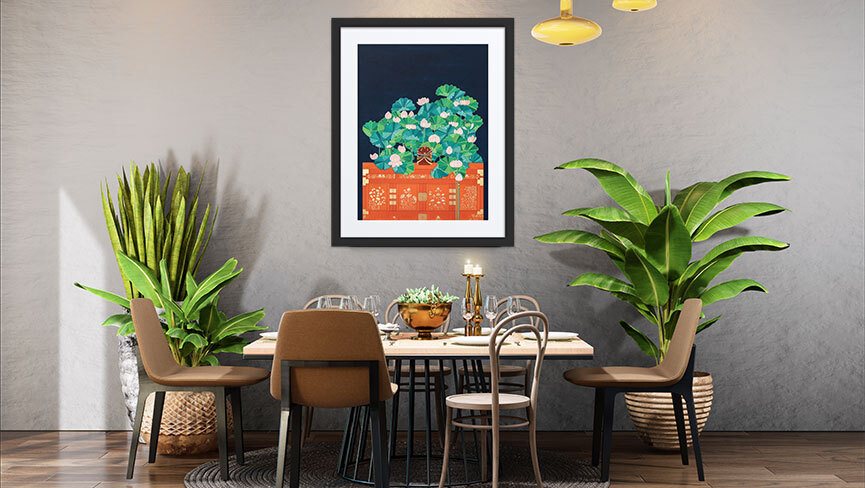
The symbolic lotuses in the painting offer a picture of how this unfolds. Lotuses rise up out of the mud to bloom. Their roots reach down into exactly the murky, difficult conditions most flowers couldn't survive. They don’t bloom in spite of the mud; they bloom because they know how to grow through it.
This is what reconnecting to our true self can look like. It's not a naive return to some untouched, perfectly unblemished version of ourselves, but a rising up that carries the whole journey with it, mud and all, into something whole.
This is the message On What Has Been Lost holds. The parts of yourself that have been lost are not lost causes. They're waiting for you to be ready to meet them again, in whatever form that takes, and let their gifts bloom in your life.
Meekyung Shin created the original painting in mixed media on Jangji, a heavy traditional Korean mulberry paper.
Bring its healing message into your space with a fine art print, available on canvas or archival paper. Find it here.